
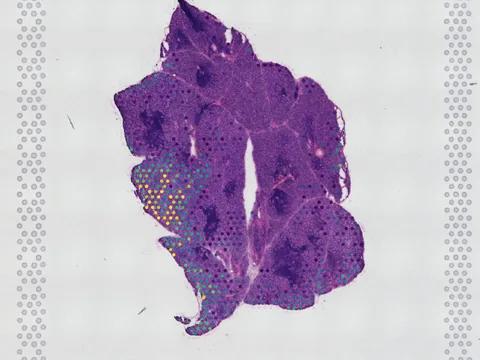
 Visium
Mouse eye
NCBI434
mouse eye Sjogren syndrome 227 MB 1,530 obs silver H&E
TechnologyVisium
Organismmouse
Tissueeye
ConditionSjogren syndrome
Obs1,530
silver H&E
import lamindb as ln
import spatialdata as sd

coll = ln.Collection.get(key="doi-10.3389/fimmu.2022.1011125")
coll.ordered_artifacts.df()                 # the 4 members, ordered

# download every member .zarr to the local cache:
paths = [a.cache() for a in coll.ordered_artifacts.all()]

# …or load each straight into memory as a SpatialData object:
sdatas = {a.key: sd.read_zarr(a.cache()) for a in coll.ordered_artifacts.all()}The lacrimal gland (LG) is an exocrine gland that produces the watery part of the tear film that lubricates the ocular surface. Chronic inflammation, such as Sjögren's syndrome (SS), is one of the leading causes of aqueous-deficiency dry eye (ADDE) disease worldwide. In this study we analyzed the chronic inflammation in the LGs of the NOD.B10Sn-H2b/J (<i>NOD.H-2b</i>) mice, a mouse model of SS, utilizing bulk RNAseq and Visium spatial gene expression. With Seurat we performed unsupervised clustering and analyzed the spatial cell distribution and gene expression changes in all cell clusters within the LG sections. Moreover, for the first time, we analyzed and validated specific pathways defined by bulk RNAseq using Visium technology to determine activation of these pathways within the LG sections. This analysis suggests that altered metabolism and the hallmarks of inflammatory responses from both epithelial and immune cells drive inflammation. The most significant pathway enriched in upregulated DEGs was the "TYROBP Causal Network", that has not been described previously in SS. We also noted a significant decrease in lipid metabolism in the LG of the <i>NOD.H-2b</i> mice. Our data suggests that modulation of these pathways can provide a therapeutic strategy to treat ADDE.
Visium 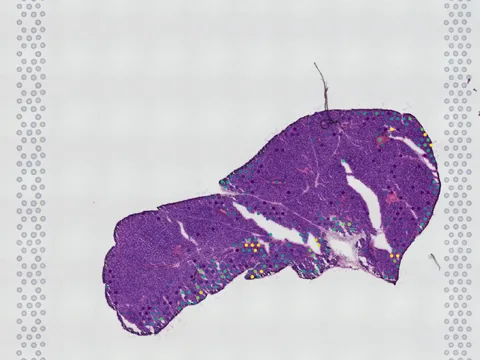 Visium
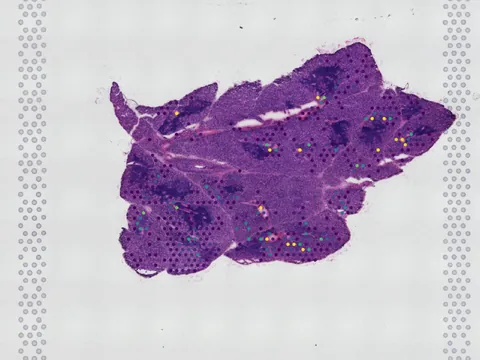 Visium
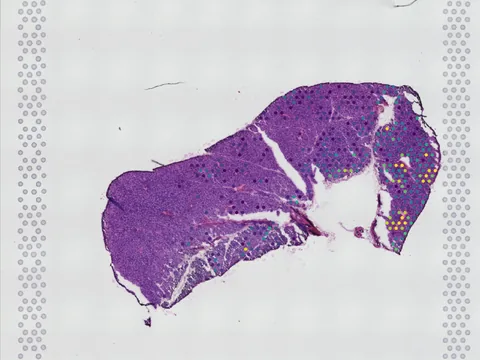 Visium
@article{Mauduit_2022,
  title = {Spatial transcriptomics of the lacrimal gland features macrophage activity and epithelium metabolism as key alterations during chronic inflammation},
  volume = {13},
  ISSN = {1664-3224},
  url = {http://dx.doi.org/10.3389/fimmu.2022.1011125},
  DOI = {10.3389/fimmu.2022.1011125},
  journal = {Frontiers in Immunology},
  publisher = {Frontiers Media SA},
  author = {Mauduit, Olivier and Delcroix, Vanessa and Umazume, Takeshi and de Paiva, Cintia S. and Dartt, Darlene A. and Makarenkova, Helen P.},
  year = {2022},
  month = Oct
}