
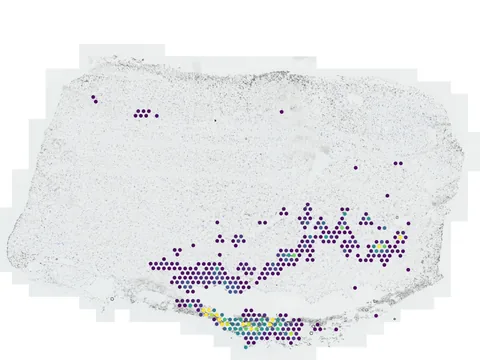
 Visium
Human locus ceruleus
GSM9656853
human locus ceruleus 49 MB 3,239 obs bronze H&E
TechnologyVisium
Organismhuman
Tissuelocus ceruleus
Obs3,239
bronze H&E
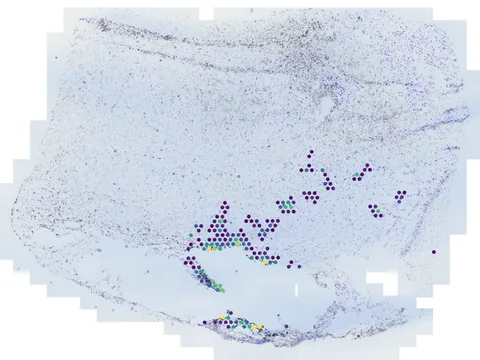
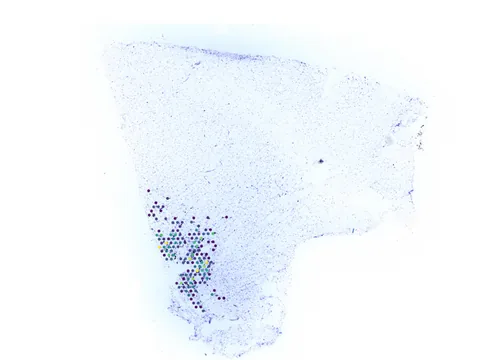
Obesity and Alzheimer’s disease (AD) are epidemiologically associated. The locus coeruleus (LC) – the brain’s primary and most significant source of norepinephrine – is one of the earliest sites of neurodegeneration in AD. The LC participates in feeding behavior through connections with the hypothalamus. The cellular composition of the LC has been characterized at single-cell resolution. However, the constituent cellular signatures of genes related to energy homeostasis – such as the melanocortin pathway genes – in the LC are unclear. We performed single-nucleus RNA sequencing and spatial transcriptomics (Visium) in the human LC, and HiPlex RNAscope in the LC of mice. The melanocortin pathway gene MRAP2 was expressed in the majority of DBH neurons across the LC. Mrap2 was also co-expressed with AD-associated genes such as App, Psen1, Psen2, and Sorl1. More than 20% of Dbh neurons in the LC were positive for Mrap2, App, Psen1, and Psen2. Mrap2 is expressed in the central nervous system and modulates the trafficking and signaling of all five G-protein coupled receptors (GPCRs) of the melanocortin receptor family: Mc1r, Mc2r, Mc3r, Mc4r, and Mc5r. In mice, among the melanocortin receptors, Mc5r showed the highest co-expression with Mrap2, accounting for 17.9% of Mrap2-positive cells, followed by Mc2r with 10.9% of Mrap2-positive cells. Mc1r, Mc3r, and Mc4r showed very limited co-expression with Mrap2. Our study reveals that many Mrap2-positive cells do not express any melanocortin receptor genes, warranting future studies into metabolically relevant GPCRs downstream of MRAP2 in the LC. In summary, our study characterizes melanocortin molecular substrates in the human and mouse LC and highlights MRAP2 as a potential link between pathways of energy homeostasis and neurodegeneration.
import lamindb as ln
import spatialdata as sd

coll = ln.Collection.get(key="geo-gse327441")
coll.ordered_artifacts.df()                 # the 4 members, ordered

# download every member .zarr to the local cache:
paths = [a.cache() for a in coll.ordered_artifacts.all()]

# …or load each straight into memory as a SpatialData object:
sdatas = {a.key: sd.read_zarr(a.cache()) for a in coll.ordered_artifacts.all()}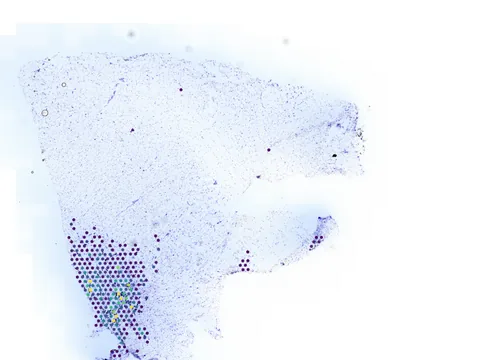 Visium
 Visium
 Visium
No linked publication found — please cite the data source.