
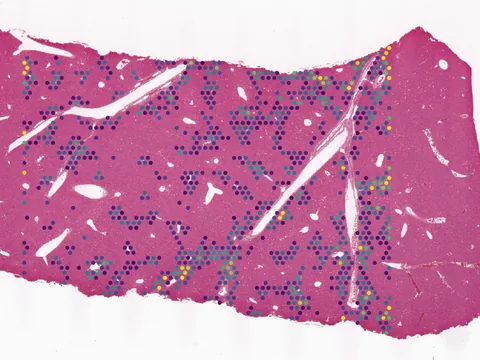
 Visium
Mouse liver
GSM9635996
mouse liver 44 MB 2,967 obs silver H&E
TechnologyVisium
Organismmouse
Tissueliver
Obs2,967
silver H&E
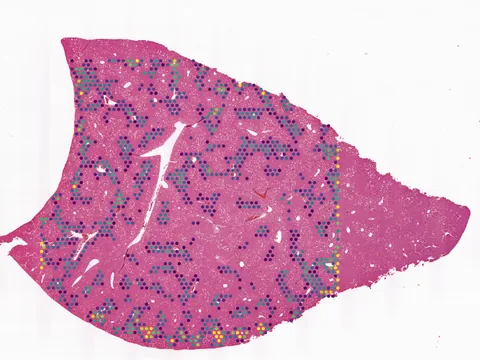
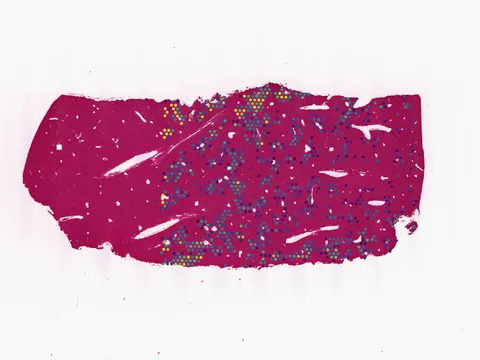
This study generated 10x Genomics Visium spatial transcriptomic profiles from mouse liver sections to investigate the effects of high-fat diet and kimchi supplementation on hepatic gene expression organization. Samples were obtained from male C57BL/6J mice assigned to normal diet (ND), high-fat diet (HFD), high-fat diet supplemented with spontaneously fermented kimchi (S-K), and high-fat diet supplemented with starter kimchi fermented with Leuconostoc mesenteroides KCKM0828 (LMS-K). The dataset was designed to assess diet-associated transcriptional changes across the liver lobule and to evaluate how kimchi intervention modulates zonation-related hepatic programs along the portal-to-central axis. Raw FASTQ files were prepared for SRA submission through GEO, and processed outputs include filtered gene-barcode matrices, HDF5 matrices, spatial coordinate files, scale factor files, tissue images, and summary reports.
import lamindb as ln
import spatialdata as sd

coll = ln.Collection.get(key="geo-gse326636")
coll.ordered_artifacts.df()                 # the 4 members, ordered

# download every member .zarr to the local cache:
paths = [a.cache() for a in coll.ordered_artifacts.all()]

# …or load each straight into memory as a SpatialData object:
sdatas = {a.key: sd.read_zarr(a.cache()) for a in coll.ordered_artifacts.all()}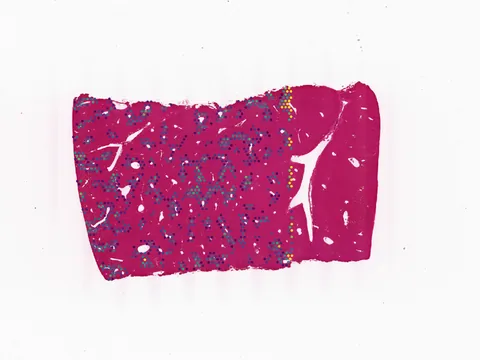 Visium
 Visium
 Visium
No linked publication found — please cite the data source.