
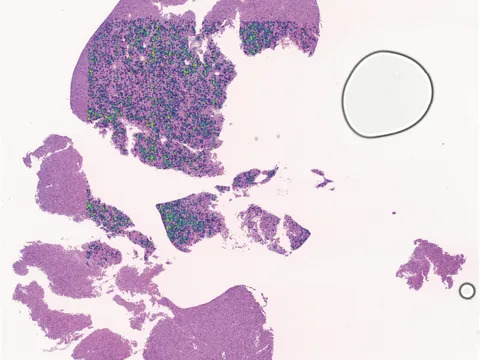
 Visium HD
Human liver
GSM9521683
human liver 641 MB 333,667 obs bronze H&E
TechnologyVisium HD
Organismhuman
Tissueliver
Obs333,667
bronze H&E
We developed Renoir, an algorithm for charting the ligand-target activities across a spatial topology. To validate this method, we generated 10x Genomics Visium HD datasets from human fetal liver samples (13 PCW and 14 PCW) and applied Renoir on these datasets. Renoir identified hepatocyte-macrophage interactions in these samples.
import lamindb as ln
import spatialdata as sd

coll = ln.Collection.get(key="geo-gse319617")
coll.ordered_artifacts.df()                 # the 2 members, ordered

# download every member .zarr to the local cache:
paths = [a.cache() for a in coll.ordered_artifacts.all()]

# …or load each straight into memory as a SpatialData object:
sdatas = {a.key: sd.read_zarr(a.cache()) for a in coll.ordered_artifacts.all()}The advancement of single-cell RNA sequencing and spatial transcriptomics has enabled the inference of cellular interactions in a tissue microenvironment. Despite advances in cell-cell interaction inference, methods capable of mapping the influence of ligands on downstream target genes across spatial niches harboring specific cell type composition, crucial for resolving niche-specific relationship between ligands and their downstream targets are still lacking. Here, we present Renoir for charting the ligand-target activities across a spatial topology, delineating spatial communication niches harboring specific ligand-target activities and spatially mapping pathway-level activity of genesets. Across spatial datasets with varying resolution (spot to single-cell) ranging from development to disease, Renoir infers cellular niches with distinct ligand-target interactions, spatially maps pathway activities, and identifies context-specific cell-cell interactions, including hepatocyte-macrophage interactions in fetal liver and interactions between onco-fetal and bipotent cells in hepatocellular carcinoma. Renoir uncovers biological insights and therapeutically-relevant cellular crosstalk from spatial transcriptomics data.
Visium HD 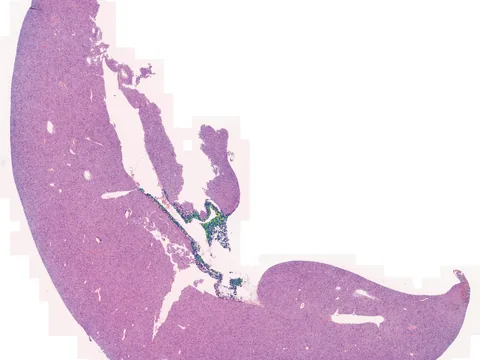 Visium HD
@article{Rao_2026,
  title = {Charting spatial ligand-target activity using Renoir},
  volume = {17},
  ISSN = {2041-1723},
  url = {http://dx.doi.org/10.1038/s41467-026-72388-7},
  DOI = {10.1038/s41467-026-72388-7},
  number = {1},
  journal = {Nature Communications},
  publisher = {Springer Science and Business Media LLC},
  author = {Rao, Narein and Kumar, Tanush and Kazemi, Dina and Hou, Shaozhi and Khakpoor, Atefeh and Eapen, Merrin Mary and Pai, Rhea and Qiao, Liang and Mishra, Archita and Ginhoux, Florent and Chan, Jerry Kok Yen and George, Jacob and Sharma, Ankur and Zafar, Hamim},
  year = {2026},
  month = May
}