
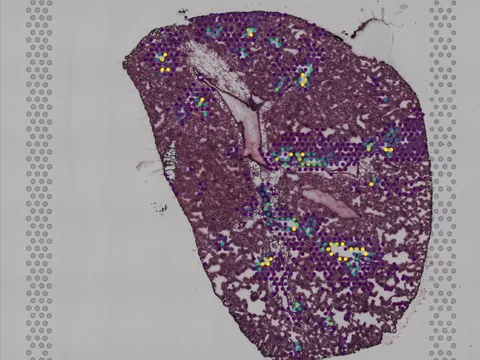
 Visium
Mouse lung
GSM9119670
mouse lung lung carcinoma 29 MB 2,697 obs bronze H&E
TechnologyVisium
Organismmouse
Tissuelung
Conditionlung carcinoma
Obs2,697
Magnificationother · 3.707 µm/px
bronze H&E
Across many solid tumor types, cancer-associated fibroblasts (CAFs) are abundant and highly heterogeneous, with distinct subpopulations exerting immunomodulatory functions. Though they have been well characterized in malignancies considered to be highly desmoplastic, how distinct CAF populations in lung adenocarcinoma (LUAD) influence the tumor–immune microenvironment is not well understood. Here, we identify a novel population of immunomodulatory CAFs (imCAFs) in the LUAD tumor microenvironment, characterized by CHL1 expression and enriched in transcriptional programs involving immune regulation and chemokine signaling. Through single-cell and spatial transcriptomics, we demonstrate that imCAFs are spatially colocalized with CXCR3+ regulatory T (Treg) cells, a hyper-suppressive T cell subset that accumulates at the tumor border. Mechanistically, imCAFs produce CXCL9, a key chemoattractant that mediates the recruitment of CXCR3+ Tregs to the tumor, promoting an immunosuppressive microenvironment. Functional profiling reveals that tumor-resident CXCR3+ Tregs possess enhanced proliferative and suppressive capacity and are transcriptionally distinct from CXCR3- counterparts. Genetic ablation of Cxcr3 in Treg cells or Cxcl9 in stromal cells significantly reduces Treg cell accumulation, resulting in enhanced CD8+ T cell activation and decreased tumor burden. Analogous CHL1+ imCAF-like fibroblasts are also observed in human NSCLC samples and were found to colocalize with Treg cells, with increased CHL1 expression in lung tumors being associated with reduced cytotoxicity scores and decreased progression free survival. These findings uncover a critical stromal–immune axis wherein imCAF-derived CXCL9 orchestrates the localization and function of hyper-suppressive CXCR3+ Tregs in LUAD and highlight the imCAF–CXCL9–CXCR3+ Treg cell recruitment circuit as a promising therapeutic target to restore anti-tumor immunity.
import lamindb as ln
import spatialdata as sd

coll = ln.Collection.get(key="geo-gse303162")
coll.ordered_artifacts.df()                 # the 2 members, ordered

# download every member .zarr to the local cache:
paths = [a.cache() for a in coll.ordered_artifacts.all()]

# …or load each straight into memory as a SpatialData object:
sdatas = {a.key: sd.read_zarr(a.cache()) for a in coll.ordered_artifacts.all()}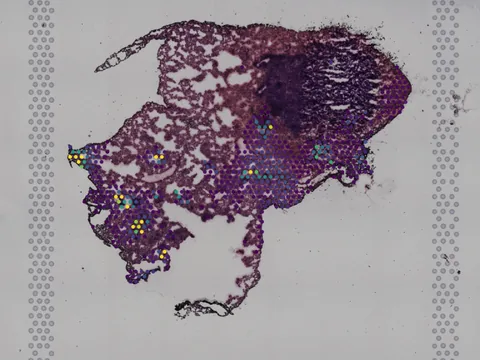 Visium
No linked publication found — please cite the data source.