
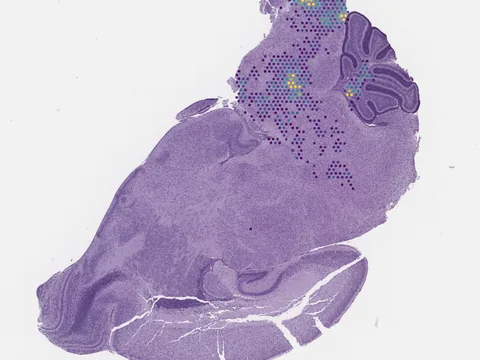
 Visium
Mouse brain
GSM9042005
mouse brain herpes simplex type 1 infectious disease 142 MB 5,990 obs silver H&E
TechnologyVisium
Organismmouse
Tissuebrain
Conditionherpes simplex type 1 infectious disease
Obs5,990
silver H&E
Subclinical neonatal infections represent a poorly understood but potentially critical determinant of long-term neurodevelopmental outcomes. Here, we show that neonatal exposure to herpes simplex virus type 1 (HSV-1), even in the absence of overt symptoms, induces persistent transcriptional and cellular changes in the brain that correlate with anxiety-like behavior later in life. Neonatal mice were subclinically infected intranasally with HSV-1 and assessed at acute (3 days post-infection) and chronic (5–6 weeks post-infection) stages using cytokine profiling, bulk RNA sequencing, and spatial transcriptomics. We observed sustained elevation of immune mediators, including CXCL10, IL-6, and IL-10, at both acute and chronic stages. Bulk RNA-seq analysis identified over 490 differentially expressed genes, with distinct expression modules that diverged significantly between early and late infection phases. Notably, several modules exhibited minimal acute changes but showed pronounced dysregulation chronically, highlighting a temporal evolution in gene expression extending beyond the initial immune response. Spatial transcriptomic analysis at the acute phase demonstrated region-specific dysregulation in pathways involving MAPK signaling, chemokine signaling, axon guidance, and long-term depression. These changes were localized to brain regions critical for affective regulation, including the midbrain, hypothalamus, and alar thalamus. Cell-type deconvolution of bulk RNA-seq data further revealed an increased abundance of astrocytes and microglia, underscoring the early involvement of glia in neuroimmune responses. Collectively, our findings illustrate that clinically silent neonatal HSV-1 infection induces spatially and temporally distinct transcriptional alterations in the developing brain. This study provides mechanistic insights into the relationship between early-life viral exposure and long-term modifications in neural circuitry and behavior, highlighting the developmental vulnerability of the neonatal brain to subclinical immune perturbations.
import lamindb as ln
import spatialdata as sd

coll = ln.Collection.get(key="geo-gse299610")
coll.ordered_artifacts.df()                 # the 2 members, ordered

# download every member .zarr to the local cache:
paths = [a.cache() for a in coll.ordered_artifacts.all()]

# …or load each straight into memory as a SpatialData object:
sdatas = {a.key: sd.read_zarr(a.cache()) for a in coll.ordered_artifacts.all()}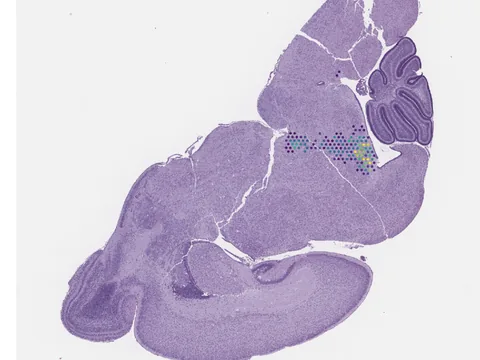 Visium
No linked publication found — please cite the data source.