Collections / Spatial Proteomics and Transcriptomics Reveal Early Immune Cell Organization in Pancreatic Intraepithelial Neoplasia

Spatial Proteomics and Transcriptomics Reveal Early Immune Cell Organization in Pancreatic Intraepithelial Neoplasia

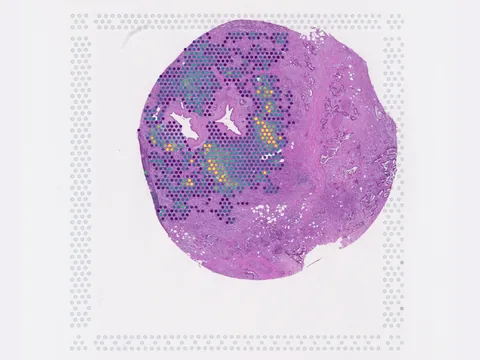
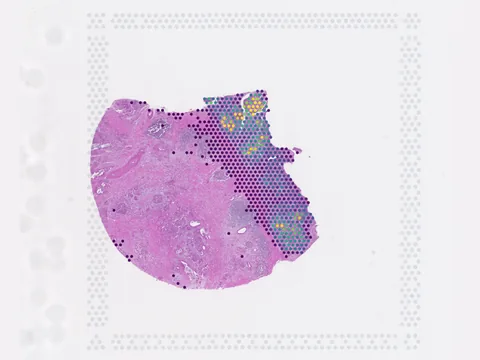
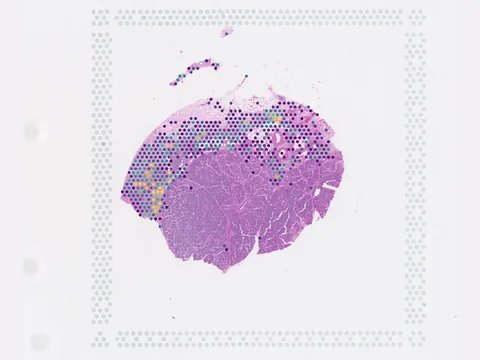
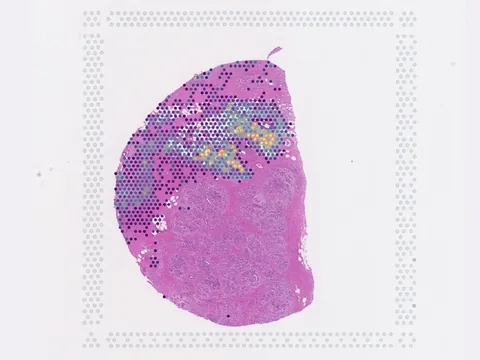
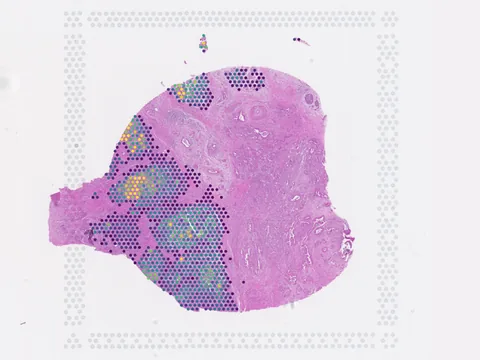
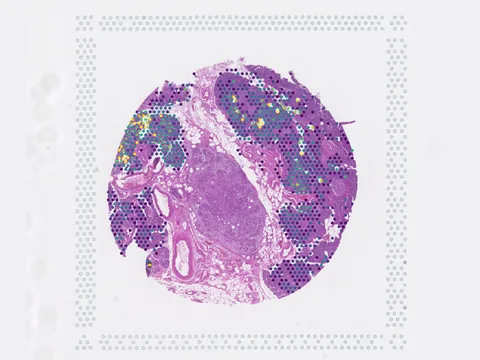
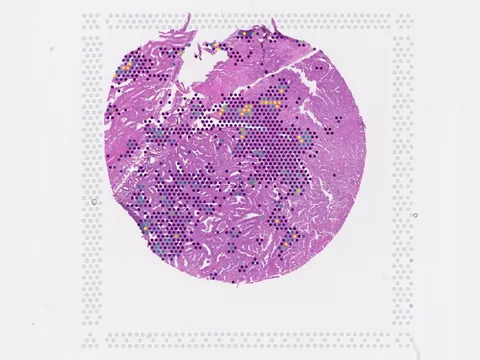
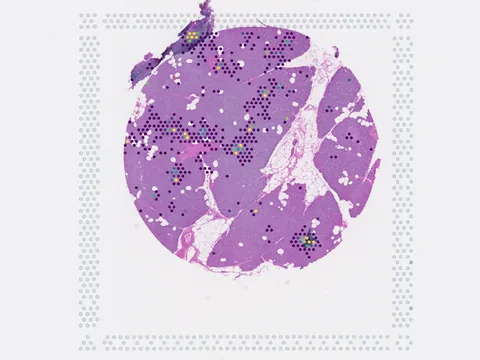
Background: Pancreatic ductal adenocarcinoma (PDAC) has a poor survival rate largely due to late detection of disease. PDAC arises from precursor microscopic lesions, termed pancreatic intraepithelial neoplasia (PanIN), that develop at least a decade before overt disease progression––this provides an opportunity to intercept PanIN–to–PDAC progression. However, immune interception strategies require a full understanding of PanIN and PDAC cellular architecture. Methods: Surgical specimens containing PanIN and PDAC lesions from a unique cohort of treatment-naïve patients with PDAC were surveyed using spatial-omics (proteomic and transcriptomic). Results: We uncovered, for the first time, the organization of lymphoid cells into tertiary lymphoid structures (TLSs) adjacent to PanIN lesions. These TLSs lack CD21+CD23+ B cells in comparison to more mature TLSs. Mature TLSs were found near the invasive PDAC border, despite patients being treatment-naïve. PanINs harbored mostly CD4+ T cells with fewer Tregs and exhausted T cells than PDAC tumors. Peri-tumoral space was enriched with naïve CD4+ and central memory T cells. Conclusions: These data show that early PanIN lesions recruit effector lymphoid populations capable of organizing into immature TLSs with few immune suppressive T cells relative to PDAC-associated TLS. These results implicate the opportunity to modulate the immune microenvironment in pre–malignant PanINs before immune exclusion and immunosuppression emerge during progression into PDACs.

Datasets13
Size~458 MB
AssayVisium
Samplehuman · pancreas
KindOther
PMID:40569674 ↗
Python · lamindb
import lamindb as ln
import spatialdata as sd

coll = ln.Collection.get(key="geo-gse294669")
coll.ordered_artifacts.df()                 # the 13 members, ordered

# download every member .zarr to the local cache:
paths = [a.cache() for a in coll.ordered_artifacts.all()]

# …or load each straight into memory as a SpatialData object:
sdatas = {a.key: sd.read_zarr(a.cache()) for a in coll.ordered_artifacts.all()}
Open in Vitessce
Visium
Human pancreas
GSM8915492
human pancreas pancreatic ductal adenocarcinoma 13 MB 2,889 obs bronze H&E
TechnologyVisium
Organismhuman
Tissuepancreas
Conditionpancreatic ductal adenocarcinoma
Size13 MB
Obs2,889
Magnificationother · 5.659 µm/px
bronze H&E Open in Vitessce
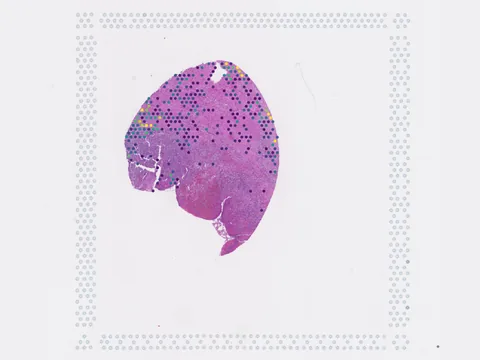
Open in Vitessce
Visium
Human pancreas
GSM8915497
human pancreas pancreatic ductal adenocarcinoma 2.5 MB 1,142 obs bronze H&E
TechnologyVisium
Organismhuman
Tissuepancreas
Conditionpancreatic ductal adenocarcinoma
Size2.5 MB
Obs1,142
Magnificationother · 5.660 µm/px
bronze H&E Open in Vitessce
Open in Vitessce
Visium
Human pancreas
GSM8915493
human pancreas pancreatic ductal adenocarcinoma 10 MB 2,847 obs bronze H&E
TechnologyVisium
Organismhuman
Tissuepancreas
Conditionpancreatic ductal adenocarcinoma
Size10 MB
Obs2,847
Magnificationother · 5.660 µm/px
bronze H&E Open in Vitessce
Open in Vitessce
Visium
Human pancreas
GSM8915495
human pancreas pancreatic ductal adenocarcinoma 28 MB 2,156 obs bronze H&E
TechnologyVisium
Organismhuman
Tissuepancreas
Conditionpancreatic ductal adenocarcinoma
Size28 MB
Obs2,156
bronze H&E Open in Vitessce
Open in Vitessce
Visium
Human pancreas
GSM8915500
human pancreas pancreatic ductal adenocarcinoma 57 MB 3,009 obs bronze H&E
TechnologyVisium
Organismhuman
Tissuepancreas
Conditionpancreatic ductal adenocarcinoma
Size57 MB
Obs3,009
Magnificationother · 5.667 µm/px
bronze H&E Open in Vitessce
Open in Vitessce
Visium
Human pancreas
GSM8915488
human pancreas pancreatic ductal adenocarcinoma 50 MB 2,567 obs bronze H&E
TechnologyVisium
Organismhuman
Tissuepancreas
Conditionpancreatic ductal adenocarcinoma
Size50 MB
Obs2,567
Magnificationother · 5.661 µm/px
bronze H&E Open in Vitessce
Open in Vitessce
Visium
Human pancreas
GSM8915499
human pancreas pancreatic ductal adenocarcinoma 54 MB 2,857 obs bronze H&E
TechnologyVisium
Organismhuman
Tissuepancreas
Conditionpancreatic ductal adenocarcinoma
Size54 MB
Obs2,857
Magnificationother · 5.669 µm/px
bronze H&E Open in Vitessce
Open in Vitessce
Visium
Human pancreas
GSM8915490
human pancreas pancreatic ductal adenocarcinoma 17 MB 1,873 obs bronze H&E
TechnologyVisium
Organismhuman
Tissuepancreas
Conditionpancreatic ductal adenocarcinoma
Size17 MB
Obs1,873
Magnificationother · 5.674 µm/px
bronze H&E Open in Vitessce
Open in Vitessce
Visium
Human pancreas
GSM8915489
human pancreas pancreatic ductal adenocarcinoma 22 MB 1,645 obs bronze H&E
TechnologyVisium
Organismhuman
Tissuepancreas
Conditionpancreatic ductal adenocarcinoma
Size22 MB
Obs1,645
Magnificationother · 5.660 µm/px
bronze H&E Open in Vitessce
Open in Vitessce
Visium
Human pancreas
GSM8915498
human pancreas pancreatic ductal adenocarcinoma 49 MB 2,397 obs bronze H&E
TechnologyVisium
Organismhuman
Tissuepancreas
Conditionpancreatic ductal adenocarcinoma
Size49 MB
Obs2,397
Magnificationother · 5.670 µm/px
bronze H&E Open in Vitessce
Open in Vitessce
Visium
Human pancreas
GSM8915491
human pancreas pancreatic ductal adenocarcinoma 49 MB 2,822 obs bronze H&E
TechnologyVisium
Organismhuman
Tissuepancreas
Conditionpancreatic ductal adenocarcinoma
Size49 MB
Obs2,822
bronze H&E Open in Vitessce
Open in Vitessce
Visium
Human pancreas
GSM8915494
human pancreas pancreatic ductal adenocarcinoma 41 MB 2,791 obs bronze H&E
TechnologyVisium
Organismhuman
Tissuepancreas
Conditionpancreatic ductal adenocarcinoma
Size41 MB
Obs2,791
bronze H&E Open in Vitessce
Open in Vitessce
Visium
Human pancreas
GSM8915496
human pancreas pancreatic ductal adenocarcinoma 65 MB 3,088 obs bronze H&E
TechnologyVisium
Organismhuman
Tissuepancreas
Conditionpancreatic ductal adenocarcinoma
Size65 MB
Obs3,088
bronze H&E Open in Vitessce

Cite this collection

No linked publication found — please cite the data source.