
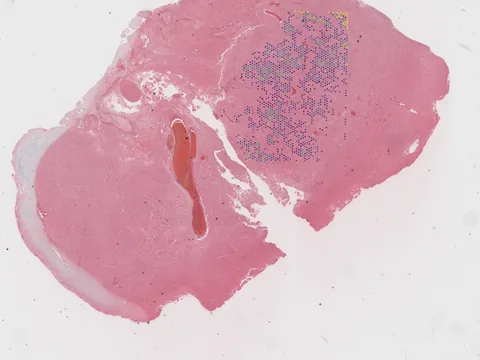
 Visium
Human brain
GSM8506649
human brain glioblastoma 121 MB 4,501 obs silver H&E
TechnologyVisium
Organismhuman
Tissuebrain
Conditionglioblastoma
Obs4,501
silver H&E
The diversity of transcriptional programs and cellular plasticity of glioma-associated myeloid cells, and thus their contribution to tumor growth and immune evasion, is poorly understood. We performed single cell RNA-sequencing of immune and tumor cells from 33 glioma patients of varying tumor grades. We identified two populations characteristic of myeloid derived suppressor cells (MDSC) that were unique to IDH wild type glioblastomas (GBM) and absent in IDH mutant low-grade gliomas and IDH mutant grade IV astrocytomas: i) an early progenitor population (E-MDSC) characterized by strong upregulation of multiple catabolic, anabolic, oxidative stress, and hypoxia pathways typically observed within tumor cells themselves, and ii) a monocytic MDSC (M-MDSC) population. Spatial transcriptomics demonstrated that the E-MDSCs geographically co-localize with a subset of highly metabolic glioma stem-like tumor cells with a mesenchymal program in the pseudopalisading region, a pathognomonic feature of GBMs associated with poor prognosis. Ligand-receptor interaction analysis revealed symbiotic cross-talk between the stem-like tumor cells and E-MDSCs in GBM, whereby glioma stem cells produce specific chemokines attracting E-MDSCs, which in turn produce growth and survival factors for the tumor cells; in particular the FGFR1 ligand FGF11. This axis is not present in IDH mutant gliomas, associated with hypermethylation and repressed gene expression of the relevant chemokine genes. Our large-scale single-cell analysis elucidated unique MDSC populations that may facilitate GBM progression and mediate tumor immunosuppression.
import lamindb as ln
import spatialdata as sd

coll = ln.Collection.get(key="geo-gse276841")
coll.ordered_artifacts.df()                 # the 2 members, ordered

# download every member .zarr to the local cache:
paths = [a.cache() for a in coll.ordered_artifacts.all()]

# …or load each straight into memory as a SpatialData object:
sdatas = {a.key: sd.read_zarr(a.cache()) for a in coll.ordered_artifacts.all()}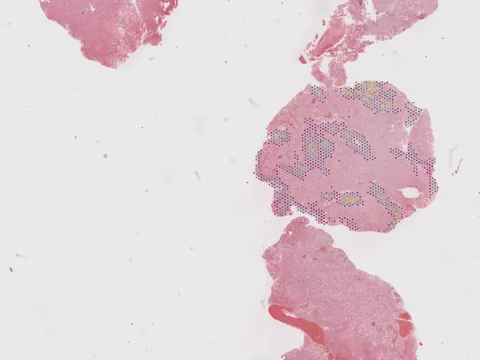 Visium
No linked publication found — please cite the data source.