Collections / Differential Activity of MAPK signalling Defines Fibroblast Subtypes in Pancreatic Cancer (Spatial Transcriptomics)

Differential Activity of MAPK signalling Defines Fibroblast Subtypes in Pancreatic Cancer (Spatial Transcriptomics)

Fibroblast heterogeneity is increasingly recognised across cancer conditions. Given their important contribution to disease progression, mapping fibroblasts’ heterogeneity is critical to devise effective anti-cancer therapies. Cancer-associated fibroblasts (CAFs) represent the most abundant cell population in pancreatic ductal adenocarcinoma (PDAC). Whether CAF phenotypes are differently specified by PDAC cell lineages remains to be elucidated. Here, we reveal an important role for the MAPK signalling pathway in defining PDAC CAF phenotypes. We show that epithelial MAPK activity promotes the myofibroblastic differentiation of CAFs by sustaining the expression and secretion of TGF-β1. We integrate single-cell profiling of post-perturbation transcriptional responses from mouse models with cellular and spatial profiles of human tissues to define a MAPKhigh CAF (mapCAF) phenotype. We show that this phenotype associates with basal-like tumour cells and reduced frequency of CD8+ T cells. In addition to elevated MAPK activity, this mapCAF phenotype is characterized by TGF-b signalling, hypoxia responsive signatures, and immunoregulatory gene programs. Furthermore, the mapCAF signature is enriched in myofibroblastic CAFs from various cancer conditions and correlates with reduced response to immune checkpoint inhibition in melanoma Altogether, our data expand our knowledge on CAF phenotype heterogeneity and reveal a potential strategy for targeting of myofibroblastic CAFs in vivo.

Datasets4
Size~192 MB
AssayVisium
Samplehuman · pancreas
KindOther
PMID:39627211 ↗
Python · lamindb
import lamindb as ln
import spatialdata as sd

coll = ln.Collection.get(key="geo-gse274665")
coll.ordered_artifacts.df()                 # the 4 members, ordered

# download every member .zarr to the local cache:
paths = [a.cache() for a in coll.ordered_artifacts.all()]

# …or load each straight into memory as a SpatialData object:
sdatas = {a.key: sd.read_zarr(a.cache()) for a in coll.ordered_artifacts.all()}
Open in Vitessce
Visium
Human pancreas
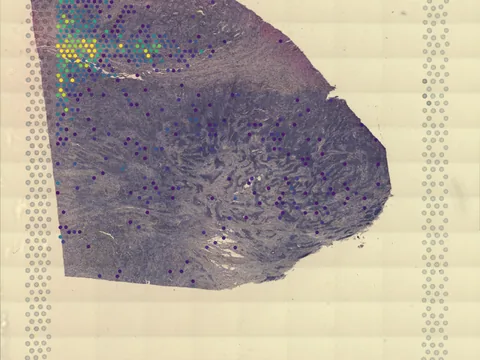
GSM8454387
human pancreas pancreatic ductal adenocarcinoma 38 MB 2,234 obs bronze H&E
TechnologyVisium
Organismhuman
Tissuepancreas
Conditionpancreatic ductal adenocarcinoma
Size38 MB
Obs2,234
Magnificationother · 3.972 µm/px
bronze H&E Open in Vitessce
Open in Vitessce
Visium
Human pancreas
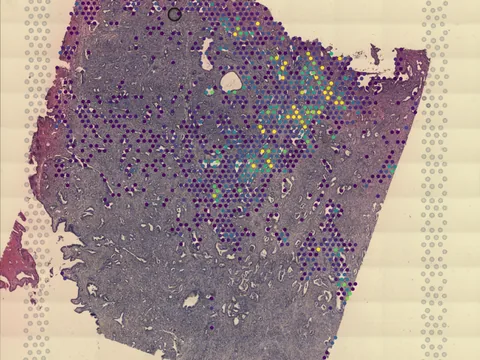
GSM8454388
human pancreas pancreatic ductal adenocarcinoma 61 MB 4,118 obs bronze H&E
TechnologyVisium
Organismhuman
Tissuepancreas
Conditionpancreatic ductal adenocarcinoma
Size61 MB
Obs4,118
Magnificationother · 3.968 µm/px
bronze H&E Open in Vitessce
Open in Vitessce
Visium
Human pancreas
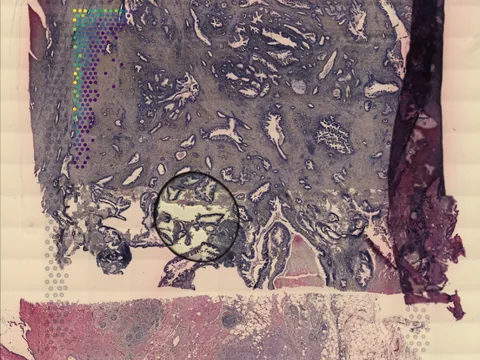
GSM8454389
human pancreas pancreatic ductal adenocarcinoma 54 MB 2,932 obs bronze H&E
TechnologyVisium
Organismhuman
Tissuepancreas
Conditionpancreatic ductal adenocarcinoma
Size54 MB
Obs2,932
bronze H&E Open in Vitessce
Open in Vitessce
Visium
Human pancreas
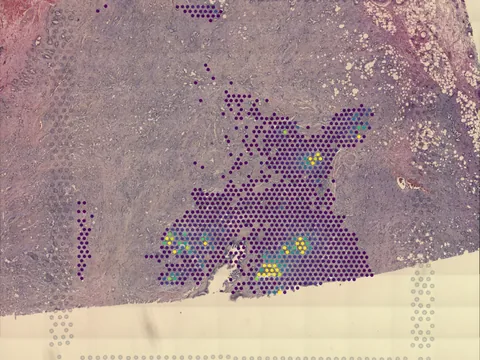
GSM8454390
human pancreas pancreatic ductal adenocarcinoma 38 MB 3,966 obs bronze H&E
TechnologyVisium
Organismhuman
Tissuepancreas
Conditionpancreatic ductal adenocarcinoma
Size38 MB
Obs3,966
bronze H&E Open in Vitessce

Cite this collection

No linked publication found — please cite the data source.