
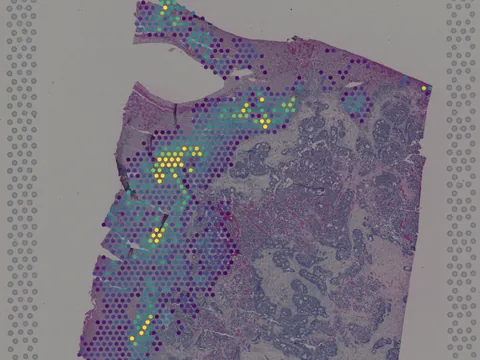
 Visium
Human liver
GSM8041062
human liver colorectal cancer 39 MB 3,070 obs bronze H&E
TechnologyVisium
Organismhuman
Tissueliver
Conditioncolorectal cancer
Obs3,070
Magnificationother · 3.352 µm/px
bronze H&E
Macrophages (Mf) are the most abundant mononuclear phagocytes in tumor tissues and hold promise as therapeutic targets and indicators of disease progression. In this work, we mapped by single-cell analysis the distinct Mf populations infiltrating the invasive margin and normal adjacent regions of human colo-rectal liver metastasis (CLM), and we exploited this information to identify non redundant markers with clinical relevance. Different populations were enriched in the invasive margin, including early-mature, inflammatory Mf (MoMf) expressing the monocytic markers S100A12 and SERPINB2, and a more mature population (TAMs) expressing CD68, GPNMB and TREM2. TAMs were enriched in pathways of matrix degradation, angiogenesis and lipid metabolism, similarly to dysfunctional macrophages described in other tumors. Cell-cell interaction analysis with CD8+ T cells defined opposing roles of MoMf, predicted to interact via IL-15, and TAMs, engaging T cells via IL-20 and IL-10. By multiplex immunofluorescence in CLM sections, we confirmed that SERPINB2 and GPNMB are expressed by different Mf subsets, with distinct topographical distribution and opposite association with patient clinical outcome.
import lamindb as ln
import spatialdata as sd

coll = ln.Collection.get(key="geo-gse254364")
coll.ordered_artifacts.df()                 # the 2 members, ordered

# download every member .zarr to the local cache:
paths = [a.cache() for a in coll.ordered_artifacts.all()]

# …or load each straight into memory as a SpatialData object:
sdatas = {a.key: sd.read_zarr(a.cache()) for a in coll.ordered_artifacts.all()}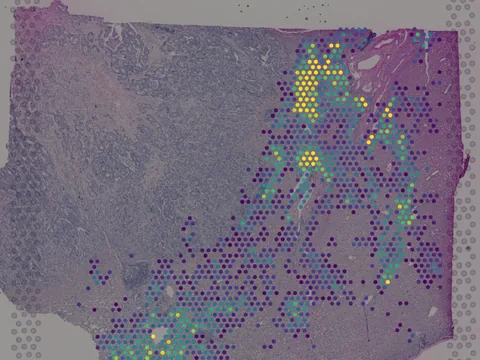 Visium
No linked publication found — please cite the data source.