
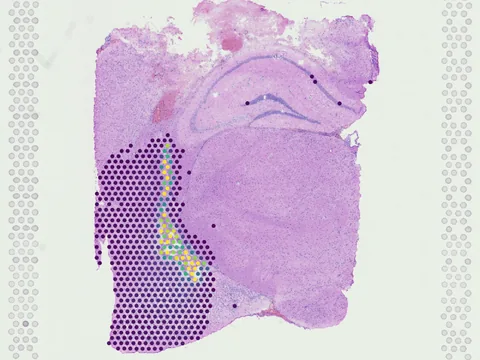
 Visium
Mouse brain
GSM7519182
mouse brain traumatic brain injury 40 MB 2,442 obs silver H&E
TechnologyVisium
Organismmouse
Tissuebrain
Conditiontraumatic brain injury
Obs2,442
silver H&E
Spatial transcriptomics (ST) is an innovative technology that holds tremendous potential for transforming the field of tissue biology research. By simultaneously capturing multiple types of spatial data, including gene expression values, spatial distance information, and tissue morphology, ST enables a comprehensive understanding of biological samples. However, the effective integration of these diverse data types remains a challenge. In this study, we present stLearn, a collection of three computational-statistical algorithms specifically designed to exploit the combined power of gene expression, spatial distance, and tissue morphology data. Our aim is to unlock novel insights into tissue maintenance, development, and disease. The first algorithm, known as pseudo-time-space (PSTS), employs a spatial-graph-based approach to uncover the spatial relationships between cells' transcriptional states in dynamic tissue contexts. To demonstrate the effectiveness of stLearn, we utilize traumatic brain injury datasets to investigate the spatio-temporal dynamics of microglia activation. By applying the PSTS algorithm to a well-established mouse model of acquired brain injury, we successfully reconstruct the spatial trajectory of microglia activation following insult, thereby validating this key component of stLearn.
import lamindb as ln
import spatialdata as sd

coll = ln.Collection.get(key="geo-gse236171")
coll.ordered_artifacts.df()                 # the 2 members, ordered

# download every member .zarr to the local cache:
paths = [a.cache() for a in coll.ordered_artifacts.all()]

# …or load each straight into memory as a SpatialData object:
sdatas = {a.key: sd.read_zarr(a.cache()) for a in coll.ordered_artifacts.all()}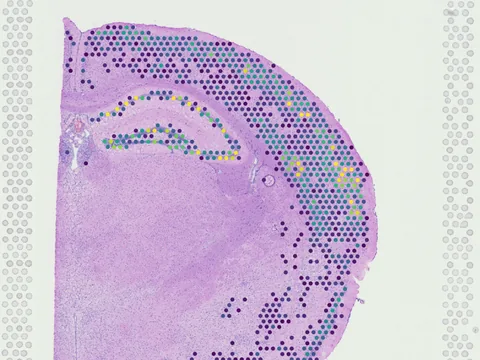 Visium
No linked publication found — please cite the data source.