
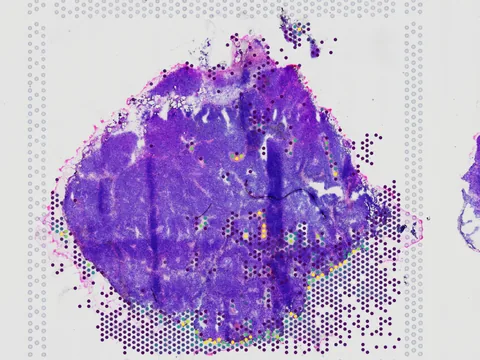
 Visium
Mouse skin of body
GSM6319698
mouse skin of body melanoma 237 MB 4,992 obs silver H&E
TechnologyVisium
Organismmouse
Tissueskin of body
Conditionmelanoma
Obs4,992
silver H&E
Although melanoma is notorious for its high degree of heterogeneity and plasticity, the origin and magnitude of cell state diversity remains poorly understood. Equally, it is not known whether melanoma growth and metastatic dissemination are supported by overlapping or distinct melanoma subpopulations. By combining mouse genetics, unbiased lineage tracing and quantitative modelling, single-cell and spatial transcriptomics, we provide evidence of a hierarchical model of tumour growth that mirrors the cellular and molecular logic underlying embryonic neural crest cell fate specification and differentiation. Our findings indicate that tumorigenic competence is associated with a spatially localized perivascular niche environment, a phenotype acquired through a NOTCH3-dependent intercellular communication pathway established by endothelial cells. Consistent with a model in which only a fraction of melanoma cells is fated to fuel growth, temporal single-cell tracing of a population of melanoma cells harbouring a mesenchymal-like state revealed that these cells do not contribute to primary tumour growth but, instead, constitutes a pool of metastatic-initiating cells that can switch cell identity while disseminating to secondary organs. Our data provide a spatially and temporally resolved map of the diversity and trajectories of cancer cell states within the evolving melanoma ecosystem and suggest that the ability to support growth and metastasis are limited to distinct pools of melanoma cells. The observation that these phenotypic competencies can be dynamically acquired upon exposure to specific niche signals warrant the development of therapeutic strategies that interfere with the cancer cell reprogramming activity of such microenvironmental cues.
import lamindb as ln
import spatialdata as sd

coll = ln.Collection.get(key="geo-gse207592")
coll.ordered_artifacts.df()                 # the 2 members, ordered

# download every member .zarr to the local cache:
paths = [a.cache() for a in coll.ordered_artifacts.all()]

# …or load each straight into memory as a SpatialData object:
sdatas = {a.key: sd.read_zarr(a.cache()) for a in coll.ordered_artifacts.all()}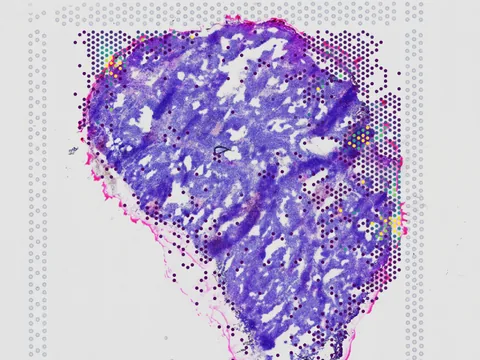 Visium
No linked publication found — please cite the data source.