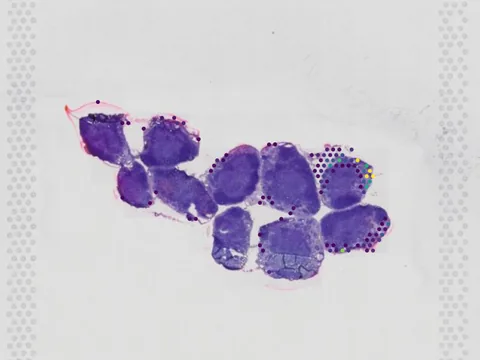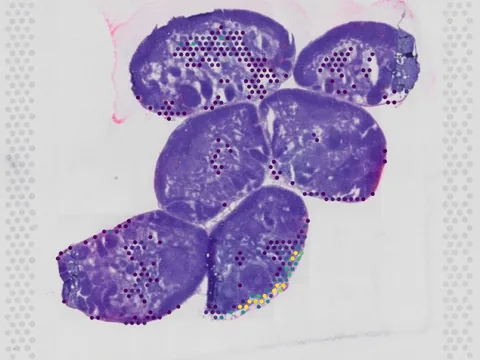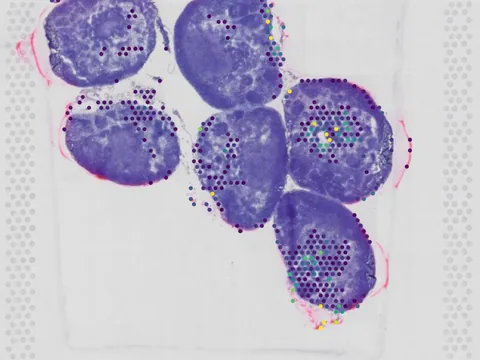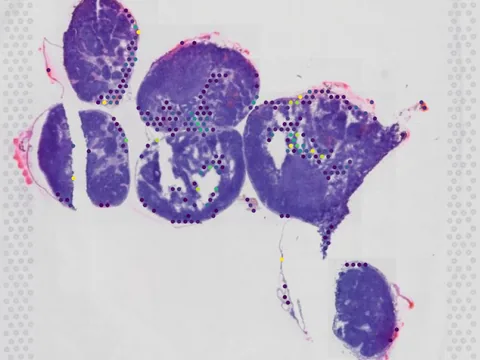
Spatial Transcriptomics of Joint-Draining Popliteal Lymph Nodes from Wild-type and TNF-Tg Mice with Early and Advanced Inflammatory-Erosive Arthritis
Lymphatic dysfunction is an integral aspect of rheumatoid arthritis (RA) pathogenesis. During "Early" arthritis in tumor necrosis factor transgenic (TNF-Tg) mice, the joint-draining popliteal lymph nodes (PLNs) dramatically expand in volume. After a prolonged expansion phase, at ~8-months-old the PLNs stochastically collapse with reduced bone volume and associated onset of "Advanced" inflammatory-erosive arthritis in affected joints. Through this pathologic process, B-cells are known to translocate into the PLN sinuses. Bulk tissue approaches (i.e. bulk genomics, flow cytometry, and ex vivo cell cultures) have been insufficient to specifically evaluate the transcriptional changes of B-cells within the sinuses of TNF-Tg PLNs. Thus, we utilized spatial transcriptomics technology to evaluate transcriptional changes in sinus B-cells and the functional genomic relationships with arthritic severity.
import lamindb as ln
import spatialdata as sd
coll = ln.Collection.get(key="geo-gse195598")
coll.ordered_artifacts.df() # the 4 members, ordered
# download every member .zarr to the local cache:
paths = [a.cache() for a in coll.ordered_artifacts.all()]
# …or load each straight into memory as a SpatialData object:
sdatas = {a.key: sd.read_zarr(a.cache()) for a in coll.ordered_artifacts.all()} Cite this collection
No linked publication found — please cite the data source.