
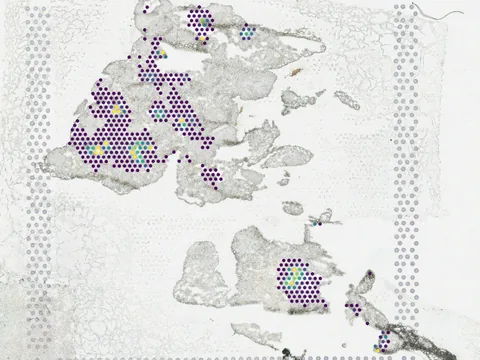
 Visium
Mouse lung
GSM5808055
mouse lung lung adenocarcinoma 30 MB 1,931 obs bronze H&E
TechnologyVisium
Organismmouse
Tissuelung
Conditionlung adenocarcinoma
Obs1,931
Magnificationother · 3.901 µm/px
bronze H&E
The cellular architecture of a tumor has a major impact on cancer outcome, and thus there is interest in identifying genes controlling the tumor microenvironment (TME). While CRISPR screens are helping uncover genes regulating many cell-intrinsic processes, existing approaches are suboptimal for identifying gene functions operating extracellularly or within a tissue context. To address this, we developed an approach for spatial functional genomics called Perturb-map, which utilizes protein barcodes (Pro-Code) to enable spatial detection of barcoded cells within tissue. We applied Perturb-map to knockout dozens of genes in parallel in a mouse model of lung cancer and simultaneously assessed how each knockout influenced tumor growth, histopathology, and immune composition. Additionally, we paired Perturb-map and spatial transcriptomics for unbiased molecular analysis of Pro-Code/CRISPR lesions. Our studies found in Tgfbr2 knockout lesions, the TME was converted to a fibro-mucinous state and T-cells excluded, concomitant with upregulated TGFb and TGFb-mediated stroma activation, suggesting Tgfbr2 loss on lung cancer cells increased TGFb bioavailability and enhanced its suppressive effects on the TME. These studies establish Perturb-map for functional genomics within a tissue at single cell-resolution with spatial architecture preserved.
import lamindb as ln
import spatialdata as sd

coll = ln.Collection.get(key="geo-gse193460")
coll.ordered_artifacts.df()                 # the 4 members, ordered

# download every member .zarr to the local cache:
paths = [a.cache() for a in coll.ordered_artifacts.all()]

# …or load each straight into memory as a SpatialData object:
sdatas = {a.key: sd.read_zarr(a.cache()) for a in coll.ordered_artifacts.all()}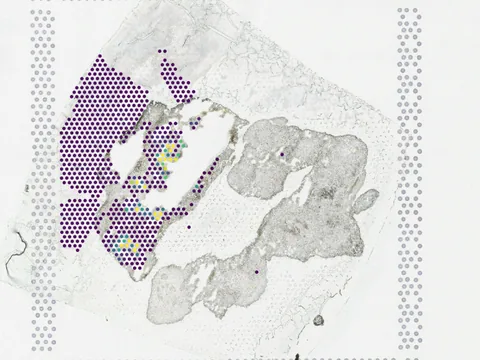 Visium
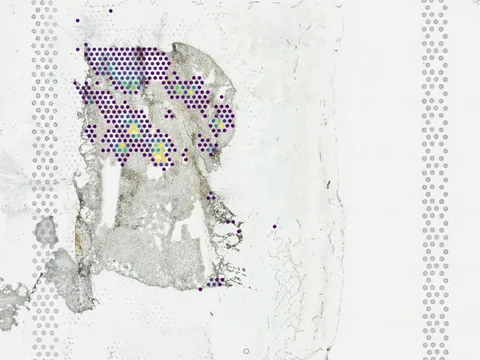 Visium
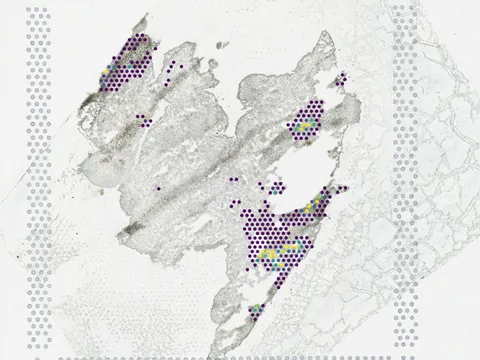 Visium
No linked publication found — please cite the data source.