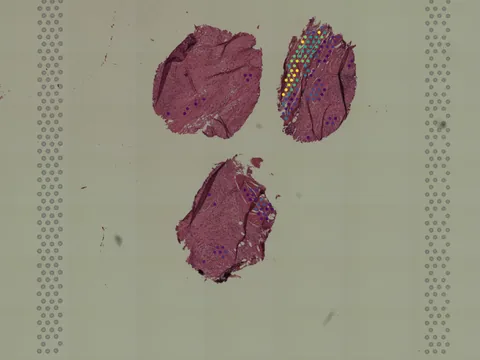
Collections / Batf3-dendritic cells and 4-1BB-4-1BB ligand axis are required at the effector phase within the tumor microenvironment for PD-1-PD-L1 blockade efficacy
Batf3-dendritic cells and 4-1BB-4-1BB ligand axis are required at the effector phase within the tumor microenvironment for PD-1-PD-L1 blockade efficacy
import lamindb as ln
import spatialdata as sd

coll = ln.Collection.get(key="doi-10.1016/j.celrep.2024.114141")
coll.ordered_artifacts.df()                 # the 2 members, ordered

# download every member .zarr to the local cache:
paths = [a.cache() for a in coll.ordered_artifacts.all()]

# …or load each straight into memory as a SpatialData object:
sdatas = {a.key: sd.read_zarr(a.cache()) for a in coll.ordered_artifacts.all()}
About the study
Batf3<sup>+</sup> DCs and the 4-1BB/4-1BBL axis are required at the effector phase in the tumor microenvironment for PD-1/PD-L1 blockade efficacy.
The cellular source of positive signals that reinvigorate T cells within the tumor microenvironment (TME) for the therapeutic efficacy of programmed death-1 (PD-1)/programmed death-ligand 1 (PD-L1) blockade has not been clearly defined. We now show that Batf3-lineage dendritic cells (DCs) are essential in this process. Flow cytometric analysis, gene-targeted mice, and blocking antibody studies revealed that 4-1BBL is a major positive co-stimulatory signal provided by these DCs within the TME that translates to CD8<sup>+</sup> T cell functional reinvigoration and tumor regression. Immunofluorescence and spatial transcriptomics on human tumor samples revealed clustering of Batf3<sup>+</sup> DCs and CD8<sup>+</sup> T cells, which correlates with anti-PD-1 efficacy. In addition, proximity to Batf3<sup>+</sup> DCs within the TME is associated with CD8<sup>+</sup> T cell transcriptional states linked to anti-PD-1 response. Our results demonstrate that Batf3<sup>+</sup> DCs within the TME are critical for PD-1/PD-L1 blockade efficacy and indicate a major role for the 4-1BB/4-1BB ligand (4-1BBL) axis during this process.
@article{Ziblat_2024,
  title = {Batf3+ DCs and the 4-1BB/4-1BBL axis are required at the effector phase in the tumor microenvironment for PD-1/PD-L1 blockade efficacy},
  volume = {43},
  ISSN = {2211-1247},
  url = {http://dx.doi.org/10.1016/j.celrep.2024.114141},
  DOI = {10.1016/j.celrep.2024.114141},
  number = {5},
  journal = {Cell Reports},
  publisher = {Elsevier BV},
  author = {Ziblat, Andrea and Horton, Brendan L. and Higgs, Emily F. and Hatogai, Ken and Martinez, Anna and Shapiro, Jason W. and Kim, Danny E.C. and Zha, YuanYuan and Sweis, Randy F. and Gajewski, Thomas F.},
  year = {2024},
  month = May,
  pages = {114141}
}

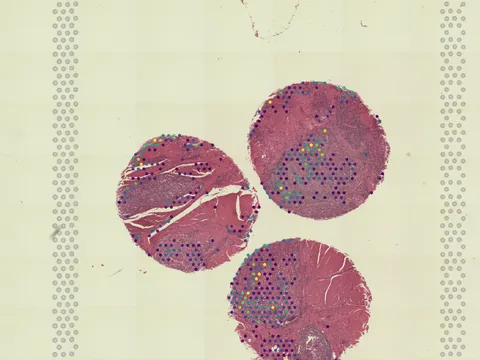 Visium